Buddies, Lauren and Joe


IMG95201508149515324223795HDR

Lauren and Joe Whalen

Yesterday Lauren went to visit one of her best buddies.  They have a special bond that only they will know.

They both had a heart transplant.

We met Joe and his family when we were living in Brigham & Women’s Hospital in Boston Ma.  Lauren already received her heart at the time, but having so many complications after the transplant, it took Lauren 5 months to recover.  During that time, we met Joe.

Joe was on the heart transplant list, he had a LVAD.  Medical reasons at that time he needed to be hospitalized for his waiting time.  I remember Joe walking with his machine doing laps around the hospital floor all the time.  Joe wanted to keep his body as strong as it could be, plus to be honest there wasn’t really anything else to do.  Walking the floor you can at least talk and meet people.  That’s how Lauren met him.  After talking with Joe, we found out he lives about 10 miles from our house.  Joe and Lauren instantly became friends.  They were great support for each other.  Joe received his gift of life in April.

Since then Lauren and Joe have kept in touch.  I feel blessed that Lauren has someone in her life that she can talk with, laugh with and I’m sure cry with.

Joe is a music teacher, so when we were living in the hospital, Joe created a song about living in the hospital.  We would joke and call the hospital the Cardiac Hotel. Please take a moment to listen to it.  It Is beautiful.

Lynne

Are you Eligble for a heart transplant ?


In my writing I want to be able to educate and give true experiences on being listed for a heart transplant.  In my daughter Lauren’s case she was in CHF.

What is congestive heart failure (CHF)?

Heart failure describes the inability or failure of the heart to adequately meet the needs of organs and tissues for oxygen and nutrients. This decrease in cardiac output, the amount of blood that the heart pumps, is not adequate to circulate the blood returning to the heart from the body and lungs, causing fluid (mainly water) to leak from capillary blood vessels. This leads to the symptoms that may include shortness of breath, weakness, and swelling.

Understanding blood flow in the heart and body

The right side of the heart pumps blood to the lungs while the left side pumps blood to the rest of the body. Blood from the body enters the right atrium though the vena cava. It then flows into the right ventricle where it is pumped to the lungs through the pulmonary artery. In the lungs, oxygen is loaded onto red blood cells and returns to the left atrium of the heart via the pulmonary artery. Blood then flows into the left ventricle where it is pumped to the organs and tissues of the body. Oxygen is downloaded from red blood cells while carbon dioxide, a waste product of metabolism, is added to be removed in the lungs. Blood then returns to the right atrium to start the cycle again.

Now it’s time for the truth. I am not going to say I am an expert, but we lived through it, and I am writing on our own experience.

We had a Dr.’s appointment with a Heart Failure Specialist in Boston Ma.  After a quick exam, we were  told
she was admitting Lauren right that day.

During that time, to be honest I had no clue what in the world was going on.  After a couple of days, a team of Dr.’s came in and introduced themselves  to us, they were the Heart Transplant Team.

They told us that they felt Lauren is at the point where she would need a heart transplant.  Her heart was getting weaker.

Trust me, it is nothing like in the movies.  If you need a transplant, you are not just put on the list.  You have to be accepted, and this is done by a committee within the hospital.  So many factors have to be considered.  It was a 4 day evaluation.  Number 1 factor was Lauren’s general health.  Next it had to be approved by your insurance, then they had to evaluate Lauren’s support system.   As you are going through this process, I remember praying that Lauren would be a candidate for heart transplant.  At the hospital where we were, the transplant team would have weekly meeting on Wednesdays.  In the meeting was the Social Worker, Transplant Team Doctors, and the surgeon.  They decide if you will be placed on the list.  The day was March 13, 2013 when the team came into Lauren’s room and said she has been placed on the Heart Transplant List as a 1A.  My thought was my daughter is going to live.

Not everyone is accepted to be placed on the donor organ list

Below is the evaluation process…..

Heart Transplant Evaluation

Patients who may be helped by a heart transplant undergo an extensive evaluation of their heart disease and general health by the Heart Transplant Team. The evaluation period is a time of learning for patients and their families. During the evaluation, the heart transplant nurse collects the patient evaluation information and presents it to the heart transplant team for discussion at a weekly meeting. The evaluation process provides information for the team to determine if the patient’s condition is severe enough for a heart transplant and if transplant is a valid option.

Typically, the evaluation includes two days of outpatient testing and interviews. Patients who are very sick may be evaluated while they are in the hospital. The evaluation includes assessments of both the cardiovascular system and the body as a whole.

Cardiovascular Tests

Cardiovascular systemassessments includes the following tests:

Chest X-ray and/or CT scan: Pictures of the heart and lungs
Electrocardiogram (EKG): Measures the electrical activity of the heart taken through patches applied to the skin
Echocardiogram: An ultrasound of the heart that reveals size and heart muscle function, as well as the valve function
Exercise stress test: Measures how well the heart is supplying oxygen to the body. Patients walk on a treadmill while their heart and oxygen levels are monitored
Right heart catheterization: Measures the pressure in the heart and lungs. A catheter for monitoring pressure is passed through a vein in the groin or neck and into the heart
General Health Tests

General health information includes a history of immunizations, medical information and dental health, as well as the following tests:

Pulmonary function test (PFT): Determines air volume in the lungs and identifies lung conditions that might be a problem after transplant
TB skin test: Identifies exposure to tuberculosis
Blood tests: Identifies blood type; tissue type; varicella zoster, hepatitis (A, B and C), toxoplasmosis, cytomegalovirus (CMV), and HIV; tests immune system, kidney and liver function and thyroid function.
Cancer screening tests: Determine if cancer is present. May include a colonoscopy and/or prostate specific antigen (PSA) for men, and a mammogram and/or Pap smear for women
Urinalysis and 24-hour urine testing
Peripheral vascular/carotid artery studies: Measure blood flow to the brain and legs, and identify any blockages in the blood vessels
Abdominal ultrasound: Checks for masses, cysts and aneurysms in the abdominal organs and blood vessels
During the evaluation, certain conditions may be identified that may prompt additional testing and consultations to further determine transplant candidacy. These concerns and appropriate treatments are discussed with patients and family members.

If the heart transplant team decides that transplant is the best option and patients agree, patients are “listed for transplant.”

Lynne 1437940979_love_valentines_day_11

A update on Lauren’s results from her Biopsy


News from Boston

Lauren had her biopsy, a couple of weeks a go.  As I said, there was no rejection.  They wanted Lauren to have her blood work done again in  week to recheck her taccrolimus levels.  They were a little low, so they upped her dosage for a week and then have it rechecked.

Tacrolimus
Drug
Tacrolimus is an immunosuppressive drug used mainly after allogeneic organ transplant to reduce the activity of the patient’s immune system and to lower the risk of organ rejection

Friday Lauren’s Dr. from Boston called and said, they have to make another adjustment.  So now they lower it a bit, and also lowered her potassium by one capsule 750mg.  Lauren has been taking 5 a day so now 4 a day.  Tacrolimus can interact with your kidneys.  So Lauren’s kidney levels were elevated. They also adjusted her torsemide from 100 mgs. twice a day to 50 mgs twice a day

Torsemide                                                                                      

Torsemide belongs to the group of medicines called loop diuretics. Torsemide is given to help reduce the amount of water in the body in certain conditions, such as congestive heart failure, severe liver disease (cirrhosis), or kidney disease. It works by acting on the kidneys to increase the flow of urine.

DSCN2776

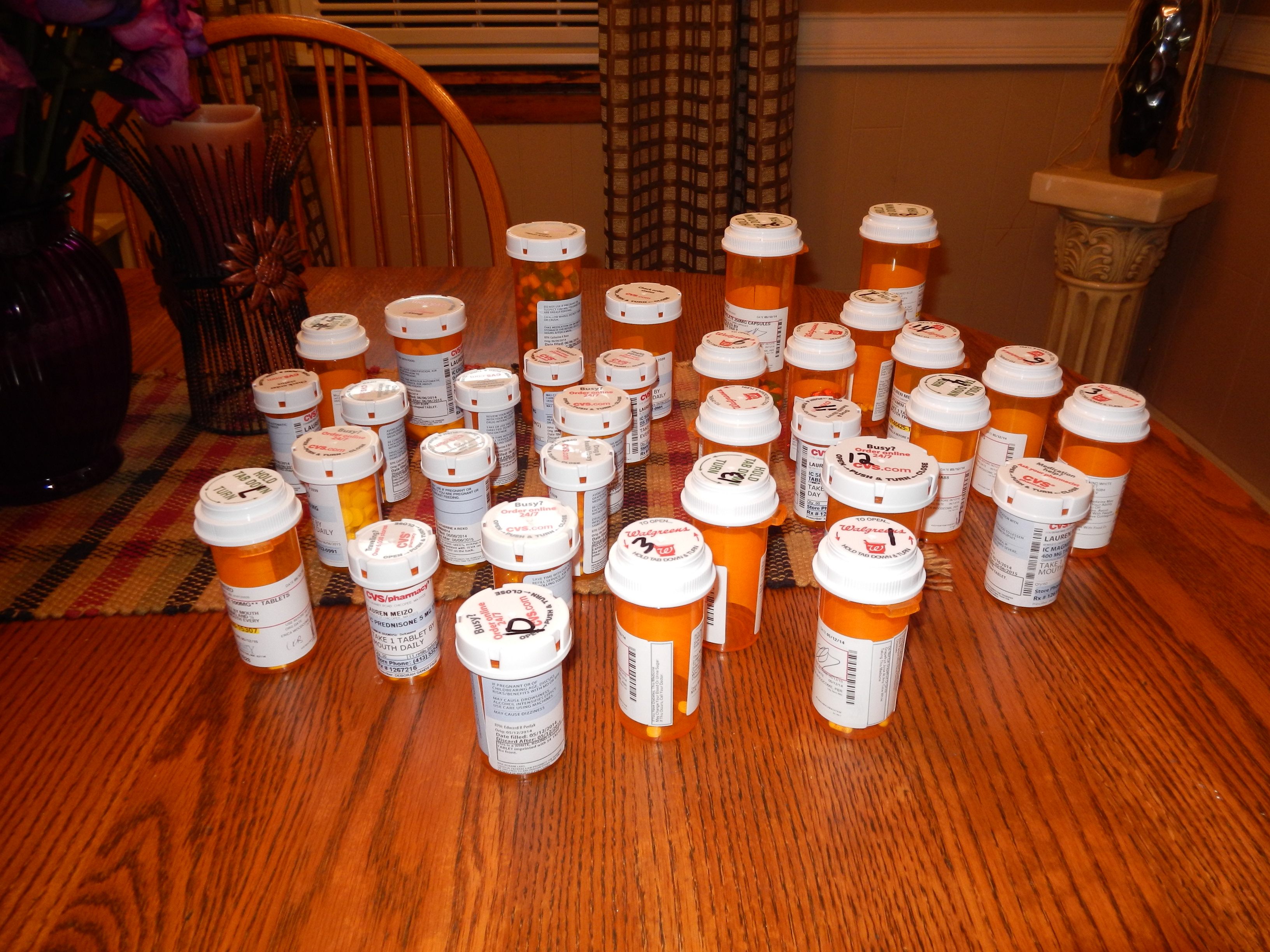
These are all the meds Lauren has to take every day.  I sometimes feel like  small pharmacy here.

Since the transplant, I have learned the lesson that medicine is a science.   It takes a lot of adjusting.  Factors can be the time she takes them, food Lauren eats, exercise and most important fluids she drinks.

Lauren takes a total of 26 pills through the day.  We fill her pill boxes once a week so everything is organized and ready for the day.

We have a new phrase around here ‘It’s that time of the month”, meaning refill time.

Lynne

Living life again


DSCN2832

This is my daughter Lauren.  A little under 2 years ago she had a heart transplant.

Look at her now.

She absolutely loves taking motorcycle rides.  Being confined in a hospital bed for a little over a year and a half, she loves the freedom she get when she takes a ride.  I was nervous about her getting on a motorcycle, but she is 25 and wants to experience all that life has to offer her now.  Plus we are very picky on whose bike she gets on.

Came across this picture and wanted to share.  Because someone was an organ donor, this picture was made possible.

Lynne

To Remember Me – I Will Live Forever please take a moment to read


I came across this short story, written by Robert Noel Test.

If you are still wondering if you should sign up to become and organ donor, please read this.  It might put your concerns into perspective.

To Remember Me – I Will Live Forever
by Robert Noel Test (1926-1994)

The day will come when my body will lie upon a white sheet neatly tucked under four corners of a mattress located in a hospital; busily occupied with the living and the dying. At a certain moment a doctor will determine that my brain has ceased to function and that, for all intents and purposes, my life has stopped.

When that happens, do not attempt to instill artificial life into my body by the use of a machine. And don’t call this my deathbed. Let it be called the bed of life, and let my body be taken from it to help others lead fuller lives.

Give my sight to the man who has never seen a sunrise, a baby’s face or love in the eyes of a woman.
Give my heart to a person whose own heart has caused nothing but endless days of pain.
Give my blood to the teenager who was pulled from the wreckage of his car, so that he might live to see his grandchildren play.
Give my kidneys to the one who depends on a machine to exist from week to week.
Take my bones, every muscle, every fiber and nerve in my body and find a way to make a crippled child walk. Explore every corner of my brain.
Take my cells, if necessary, and let them grow so that, someday a speechless boy will shout at the crack of a bat and a deaf girl will hear the sound of rain agianst her window.
Burn what is left of me and scatter the ashes to the winds to help the flowers grow.
If you must bury something, let it be my faults, my weakness and all prejudice against my fellow man.
Give my sins to the devil.
Give my soul to God.
If, by chance, you wish to remember me, do it with a kind deed or word to someone who needs you. If you do all I have asked, I will live forever.

About the Author
Robert N. Test was one of the pioneers in promoting organ and tissue donations. In 1976, he wrote an essay titled “To Remember Me.” It was first published in The Cincinnati Post and later in Ann Landers’ column, as well as in Reader’s Digest.

Lynne