A update on Lauren’s results from her Biopsy


News from Boston

Lauren had her biopsy, a couple of weeks a go.  As I said, there was no rejection.  They wanted Lauren to have her blood work done again in  week to recheck her taccrolimus levels.  They were a little low, so they upped her dosage for a week and then have it rechecked.

Tacrolimus
Drug
Tacrolimus is an immunosuppressive drug used mainly after allogeneic organ transplant to reduce the activity of the patient’s immune system and to lower the risk of organ rejection

Friday Lauren’s Dr. from Boston called and said, they have to make another adjustment.  So now they lower it a bit, and also lowered her potassium by one capsule 750mg.  Lauren has been taking 5 a day so now 4 a day.  Tacrolimus can interact with your kidneys.  So Lauren’s kidney levels were elevated. They also adjusted her torsemide from 100 mgs. twice a day to 50 mgs twice a day

Torsemide                                                                                      

Torsemide belongs to the group of medicines called loop diuretics. Torsemide is given to help reduce the amount of water in the body in certain conditions, such as congestive heart failure, severe liver disease (cirrhosis), or kidney disease. It works by acting on the kidneys to increase the flow of urine.

DSCN2776

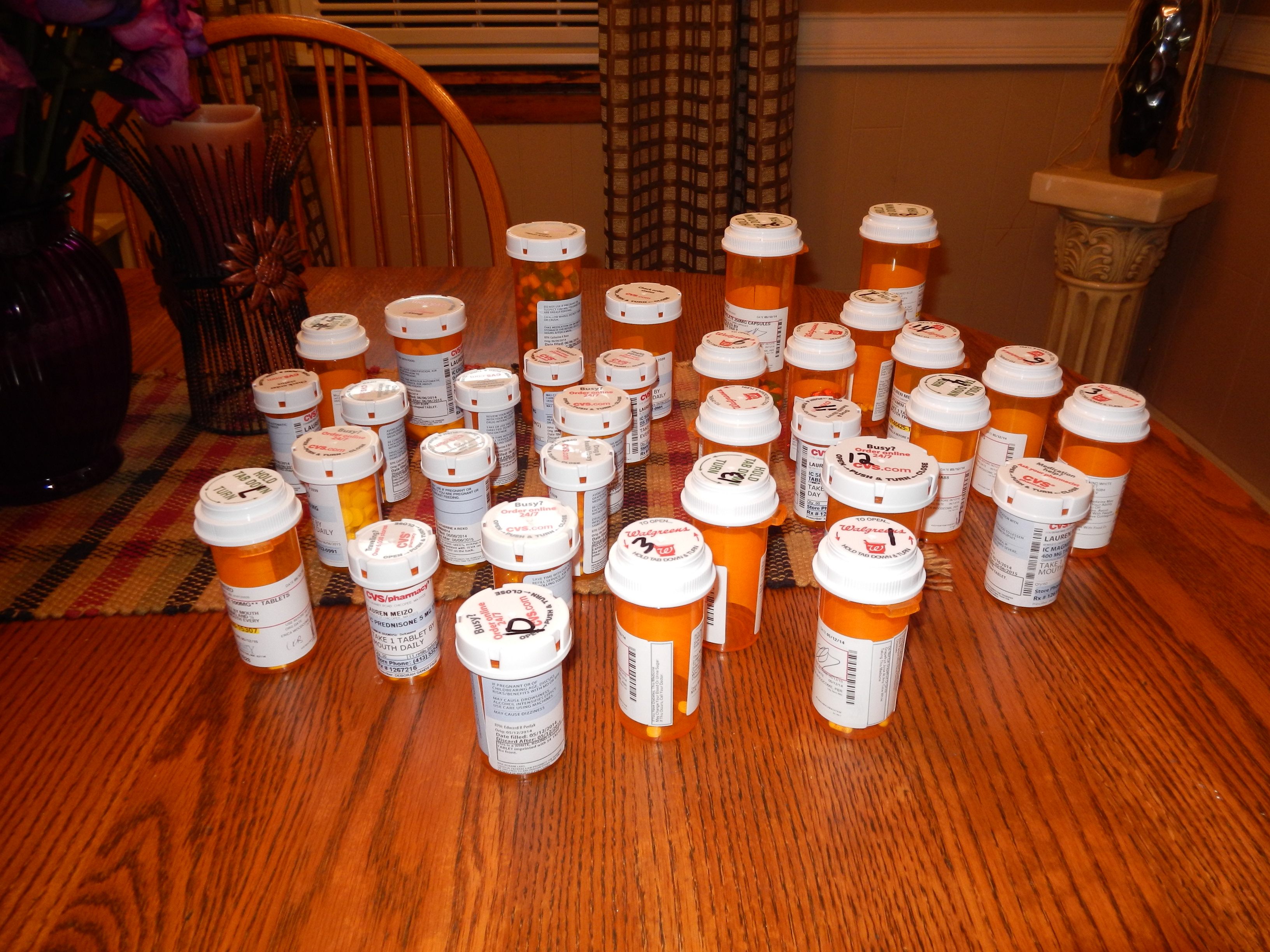
These are all the meds Lauren has to take every day.  I sometimes feel like  small pharmacy here.

Since the transplant, I have learned the lesson that medicine is a science.   It takes a lot of adjusting.  Factors can be the time she takes them, food Lauren eats, exercise and most important fluids she drinks.

Lauren takes a total of 26 pills through the day.  We fill her pill boxes once a week so everything is organized and ready for the day.

We have a new phrase around here ‘It’s that time of the month”, meaning refill time.

Lynne

The weekend is here !!!!!!!!!!!!!!


157487-Happy-Weekend

Time to relax, with a big cold one.

About 3 months ago the weekend really didn’t mean that much to me.  You see, I stay at home taking care of my daughter.  Even though she is 25 years old, I am listed as her caretaker.  Lauren has a form of MD, so she still isn’t as strong as she used to be before her heart transplant. As a caregiver for Lauren, the weekends don’t mean anything to me.  That part of my life is the same no matter what day it is.

But, now this is a big but, the weekends do mean, take some time for myself.  Couple of months ago, my husband blatantly told me I am entitled to enjoy the weekends.  He has been telling me this for a while, but I finally listened to him.  In that content, to me it means….no laundry, no yard work, no mopping the floors, no ironing, anything that I can get done during the week when he is at work, so on the weekend we can relax together.  It was hard at the beginning, but I put a schedule together on certain days, all the choir are to be done.

I can honestly say, I am not the type of person who knows how to relax.  I always have to be doing something.  I always felt guilty if I was just chilling out.  I had to learn, I’m entitled to relax just like everyone else.

So, I learned how to do this. Now I can sit by the pool with my husband, or watch a movie on a lazy Saturday.

With that being said

Enjoy your WEEKEND

LYNNE

Friendships, old and new


Friendships……we all have them.  Some are close and some are distant.  Some are family members and some are people you haven never met face to face.

people-holding-hands-around-world-57073

When I think of all the friends I have, my mind thinks of everyone I care about.  I am blessed to be able to say that my husband IS my best friend.

I have 2 girlfriends that I have been friends with for over a decade.  We may not talk everyday or even for weeks, but I know they are there for me and I will always be there for them, no matter what.

My daughter, Lauren calls me her best friend.   We have been through much together.  Not only mother daughter stuff, but just hanging out together.  I feel we have a very special relationship.

Then I have special neighbors I call friends.  Again, I can say I am very blessed to live in the best neighborhood in the world.

And now I have many new friends, that I have met writing this blog.  I can honestly say I know people all over the world.

 When I meet  someone who has gone through some life experiences similar to mine, there is a bond we share.  Then a friendship begins.

In writing this post, I  would like to say, it really made me stop many times to   think of everyone I love, family and friends.  I would not be the person I am today without them.

Much Love, Lynne

Being totally exhausted


This is how I feel today….

Exhausted

Have you ever felt this way?

I know that most of you answer yes to this.  It is normal, life is exhausting.  Being physical or emotional or at times just both.  Today, I’m emotionally exhausted.  The last couple of days did me in.

Sometimes I just sit back and think, oh you are stronger than this, hell you spent almost 2 years living in a hospital with your daughter.  Seeing my husband only on weekends, then dealing with watching my daughter at the beginning get weaker, then after the transplant watching her struggle to get better.

The nightmares do not go away, they fade, but they are always there.  Whenever Lauren has a procedure done, it takes so much out of me.  I say to myself, “I can’t do that again”, but if I needed to, I know I would be able to find the strength.

All the news was good, so it’s time to take a deep breath and take a little time for myself.  I think I only need an hour or two.  Maybe, I need to watch a good Life Time movie to relax.

All of our lives are different, some the same in ways and others totally different, but I do know we all get emotionally exhausted at times, no matter who we are.  And I guess that’s ok.

MAKE THE MOST OF TODAY AND TRY TO MAKE TOMORROW BETTER.

Thanks for listening

Lynne

It’s about nurturing,


After a month and a half of watering, weeding and pruning I finally picked my first tomato.  There are many to come, not ready yet, but soon.

20150707_102017

When you nurture something or someone, you take so much pride in the outcome.

Nurturing can take on so many meanings, depending on your life style.  It could be a new puppy, a vegetable garden, your lawn, and to some of us our children.

Here’s a thought, it may not always turn out the was we expect, or anticipate, all we can say to ourselves is we did the best we can.

Maybe you can take a moment and think about everything or everyone you nurture in your life.

Just a thought for the day.

Lynne

Caregiver Burnout, omg it is real. Take the quiz


This is a follow-up on yesterday’s post.  I was doing some research on Caregivers and I came across this article.  I thought I was just depressed, come to find out I’m just getting burnt out.  It is a real condition.

To tell you the truth, I do feel little guilty looking this up, reason being I do not want Lauren thinking I blame her for these emotions I feel.

When I just typed that last line, I realized I was thinking of her, when I need to think of myself now and then.  I know I have taken the first step to identify, now it is time to recognize, then to take steps get a healthier outlook.

Please take the time to read this article even if you are not a Caregiver.  You may know someone who is a Caregiver or possibly just taking care of your own family can be overwhelming at times.
What Causes Caregiver Burnout?

  • Caregiver burnout is a state of physical, emotional, and mental exhaustion that may be accompanied by a change in attitude — from positive and caring to negative and unconcerned. Burnout can occur when caregivers don’t get the help they need, or if they try to do more than they are able — either physically or financially. Caregivers who are “burned out” may experience fatigue, stress, anxiety, and depression. Many caregivers also feel guilty if they spend time on themselves rather than on their ill or elderly loved ones.
  • What Are the Symptoms of Caregiver Burnout?
    The symptoms of caregiver burnout are similar to the symptoms of stress and depression. They include:
  • Withdrawal from friends and family
    Loss of interest in activities previously enjoyed
    Feeling blue, irritable, hopeless, and helpless
    Changes in appetite, weight, or both
    Changes in sleep patterns
    Getting sick more often
    Feelings of wanting to hurt yourself or the person for whom you are caring
    Emotional and physical exhaustion
    Excessive use of alcohol and/or sleep medications
    Irritability
  • Are You Heading for Caregiver Burnout?

By Paula Spencer Scott, Caring.com contributing editor
188 Comments 96% helpful concerned_woman
Caregiving can bring many positives into your life — but it’s also hard work, physically and emotionally. If you don’t take enough self-care to replenish yourself, then caregiver stress, anxiety, and depression can build.

And that puts you on the path for caregiver burnout, a syndrome of mental, emotional, and physical depletion. “Caregiving requires a certain amount of selflessness, but it’s important for caregivers to know their limits,” says Caring.com senior medical editor Ken Robbins, a geriatric psychiatrist at the University of Wisconsin who’s also board certified in internal medicine. “Caregivers can become so focused on the person they’re assisting that they neglect their own needs.”

Caregiver burnout interferes with your ability to function. Burnout also raises your risk of chronic depression and other mental and physical ailments, from hypertension and flu to diabetes, stroke, or even premature death. Caregiver burnout is also a leading cause of nursing home placement, when run-down caregivers become too depleted to manage caregiving demands.

“It’s important for caregivers to be aware of this phenomenon and to find ways to either prevent or minimize it when they realize it’s happening,” Robbins says.

What’s your caregiver burnout index? Answer the following 12 questions, add up your score (A = 4 points, B = 3 points, C = 2 points, D = 1 point), and learn lifesaving strategies for managing the unique stress of caregiving.

  • 1. How often do you get a good night’s sleep (seven or more hours)?

a. Every day

b. Often

c. Sometimes

d. Seldom or never

  • 2. How often do you keep up with leisure activities that you enjoyed before caregiving?

Every day

Often

Sometimes

Seldom or never

  • 3. How often do you feel irritable or lose your temper with others?

Seldom or never

Sometimes

Often

Every day

  • 4. How often do you feel happy?

Every day

Often

Sometimes

Seldom or never

  • 5. How often do you find it difficult to concentrate?

Seldom or never

Sometimes

Often

Every day

  • 6. How often do you need a cigarette(s) or more than two cups of coffee to make it through the day?

Seldom or never

Sometimes

Often

Every day

  • 7. How often do you lack the energy to cook, clean, and take care of everyday basics?

Seldom or never

Sometimes

Often

Every day

  • 8. How often do you feel hopeless about the future?

Seldom or never

Sometimes

Often

Every day

  • 9. How often are you able to relax without the use of alcohol or prescription sedatives?

Every day

Often

Sometimes

Seldom or never

  • 10. How often do you feel overwhelmed by all you have to do?

Seldom or never

Sometimes

Often

Every day

  • 11. How often has someone criticized your caregiving or suggested you’re burning out?

Seldom or never

Sometimes

Often

Every day

  • 12. How often do you feel that someone is looking after or caring for you?

Every day

Often

Sometimes

Seldom or never

How did you score?

This self-test isn’t a scientific or diagnostic measure; it’s meant to help you identify whether your stress level warrants taking steps toward better protecting yourself.

Add up your score. Each A = 4 points, B = 3 points, C = 2 points, D = 1 point.

  • 48-42: Keeping your cool (low burnout risk)

Your heart and head are both in the right place, and your stress-busting reservoirs are full, which helps you to give with grace and good humor. That said, caregiver stress often creeps up without a caregiver realizing it. Protecting your healthful habits is paramount.

What to do: Keep yourself well fueled for caring by making time for yourself every day — at minimum, aim for several five-minute pick-me-ups for caregiver stress. If you’re in a relationship, know that a healthy marriage or other close relationship can be a source of strength; learn how caregiving couples can make it work.

  • 30-41: Feverish (elevated burnout risk)

You’re likely managing caregiver stress reasonably well but falling into a common caregiver trap: Letting yourself sink lower on the daily priority list than is healthy for you. Everyone has an occasional crazy-busy day, but too many of them results in chronic stress — which erodes well-being and places you at risk for depression, colds, and other illnesses.

What to do: Protect your time for self-care by learning seven ways to find more “me” time. On days when you’re feeling stressed, try these five ten-minute pick-me-ups.

  • 18-29: Too hot to handle (high burnout risk)

Your stress level is probably sky-high. You may already be experiencing symptoms of anxiety, depression, compromised immunity, and physical exhaustion that can lead to or complicate chronic diseases such as hypertension, diabetes, heart disease, and chronic depression. It’s critical that you take steps immediately to lower your stress level, ideally through a combination of better self-care, a shared workload, and outlets for your complicated emotions, including talk therapy and support groups.

What to do: In addition to the suggestions in the sections above, learn the five real reasons you’re stressed and how to tame them. Look into respite care options — they’re an important way to give yourself the break you need.

  • 12-17: Toast (already burned out)

It’s a wonder — and a blessing — that you were able to find and take this quiz. You’re running on empty, or is it more like barely running? Although you want to do your best for the person you’re caring for, realize that your own health is at stake — and if you don’t look out for Number One, you won’t be able to help the person or persons in your care.

What to do: You need immediate help. Learn how to tell the difference between the normal stress of caregiving and depression and consult with someone you trust — a doctor, clergyperson, counselor, or therapist, for counseling — and seek out medical assistance. At minimum, you need a physical checkup. You may also benefit from other therapies or from a break from caregiving that’s as short-term as a vacation or as permanent as a relocation of the person in your care.

Well, I took the test.  It opened my eyes to help recognize I need to take steps to learn to take time for myself.

I would like to take the opportunity to thank my family and friends for being patient and understanding during the last couple of months.

lynne

Being a Caregiver. Do you think it is a real job?


I decided to write this post for many reasons on this subject.  When you think of someone who is a caregiver what comes to your mind?  For most, I can only guess it’s a nurse or some other medical professional that is hired from a company that comes to your house to care for mostly elderly individuals.  I am not going to say you are wrong, because you’re not, but there is so much more in Caregiving.

My name is Lynne Robitaille and I am a Caregiver for my daughter Lauren. She is a  25 years old women who  had a heart transplant one year ago and also has a rare muscle disease  called Lainge Distal Myopathy.  Lauren’s muscle disease is a form of Muscular Dystrophy, which  only effect her distal muscles being her ankles, hands, neck.  She has weakness in those areas.  Lauren also has scolosis.

This is my daughter Lauren.  The picture was taken in Punta Cana, we took a family vacation when Lauren got the ok to travel this past February.  A trip we promised her when she was in the hospital.  It gave her something special to look forward to.  When you are recovering from such a life changing surgery, the Dr.’s and nurse’s heal the body, so we needed to work on her emotional state of mind. Giving her the motivation to get to the Island’s was ours.

DSCN2976

When someone becomes a Caregiver, is could be for anyone that is in need.  When that person is your child, you  would never in your mind consider yourself as their Caregiver.  Your mom.  You have always taken care of your child since birth and will do forever.  But then, I was approached when we were ready to the hospital this question.  “Who is going to be Lauren’s Caregiver”?.  I remember just looking at the Dr’s and the social worker, with this look on my face, excuse me, what did they just ask me.  Who? who?

Lauren had undergone so much in hospital that even when she was going to be discharged she would need assistance is her medical condition and every day living skills.  Medically, she came home with a trac that was not removed yet and a  feeding tube she still needed.  On top of these obstacles, Lauren’s blood sugar had to be checked twice a day, medication had to be administered, feeding tube had to be set up in the evenings and she needed to be put on a ventilator with her trac in the evening when she slept.

That was  the medical part, now everyday living is a different story.  Help was needed in all aspect of just daily living.  Up and down stairs, laundry, preparing meals, personal hygiene, transportation, and anything else she needed help with in daily living.

So getting back to when I was approached as to whom is going to be Lauren’s Caregiver, the hospital told me that they could not discharge her if they didn’t have a name.  They wanted to contact resources here in Chicopee to have someone come to our house to help with Lauren.  I flat-out told them NO, I was going to be her Caregiver.  Living with her in the hospital, I was trained in all the aspect of her medical conditions and being her mother I had experience in taking care of her with daily living.  So that is when I became Lauren’s Caregiver.

I found an organization here in Massachusetts that helps Caregivers.  It is called Caregiver Homes of Massachusetts. I had to fill out an application to be accepted into this program.  Then they come out to your house to asse you and the patient.  If approved, me being Lauren’s Caregiver, I can get compensated for Lauren care.  You are given a  Case Management team Registered Nurse and Care Manager.  This professional team visits us every month.  In the beginning it was a great piece of mind for me with all the medical care she needed.  I didn’t feel so alone.  Now as time has gone by, we are reaching our one year, it is only daily living skills Lauren still needs help with.  Moving forward.

I looked up the definition of a Caregiver, this is what it stated:

Caregiver
From Wikipedia, 

A caregiver or carer is an unpaid or paid person who helps another individual with an impairment with his or her activities of daily living. Any person with a health impairment might use caregiving services to address their difficulties. Caregiving is most commonly used to address impairments related to old age, disability, a disease, or a mental disorder.

Typical duties of a caregiver might include taking care of someone who has a chronic illness or disease; managing medications or talk to doctors and nurses on someone’s behalf; helping to bathe or dress someone who is frail or disabled; or taking care of household chores, meals, or bills for someone who cannot do these things alone.

With an increasingly aging population in all developed societies, the role of caregiver has been increasingly recognized as an important one, both functionally and economically.

Now, another reason I wanted to write this post is, I believe people need to understand what a Caregiver is.

It is a full-time job.  I was approached and asked when or if I was going to get a real job now that Lauren is getting better.  I have heard that question before but just decided to ignore it.  My thoughts were they don’t know how much effort goes into taking care of someone 24/7.   Being a Caregiver is a full-time job.  People rely on you.  There is no sick days. leaving early, punching out or saying “thank god the week-end is here”.  It is a real job, with low or no pay.

If you know someone who is a Caregiver, please give them the recognition they deserve.  Taking care of another person especially an adult who is set in their ways is not easy.

Lynne Robitaille – Caregiver