Sum up Lauren’s last surgery


2 years after my daughter Lauren had heart transplant, in January Lauren had her yearly biopsy.  The biopsy came back no rejection, but they found she had  an arteriovenous (AV) fistula  which is an abnormal connection between an artery and a vein. Normally, blood flows from your arteries to your capillaries to your veins. After meeting with a Vascular surgeon, they scheduled surgery to correct the fistula.  Since Lauren’s transplant her blood flows have always been high, but the Dr.’s didn’t seem to concerned to much about it.  The main concern was the body wasn’t rejecting the heart. The surgery was scheduled a couple a weeks ago at Brigham and Women’s Hospital in Boston Ma.  We were told the surgery would be around 2 hours and they were going to admit Lauren in the hospital over night just for observation.

My husband Dean and I were nervous about Lauren having to go through another surgery after everything she has been through, in the back of our minds we knew there are always chances of complications with any surgery.  Not to mention how Lauren felt about another surgery.  The three of us talked and agreed it was going to be a quick surgery, and also Lauren wanted to be able to see some of the wonderful people that helped her get through her life changing experience again.

Every time I go back to Brigham’s I have anxiety, to many memories of when we were living there.  My husband has a wonderful way of keeping me and Lauren calm to get through it.  We are two lucky women to have him in our lives.

We arrived at the hospital 6:00 a.m., Lauren’s surgery was scheduled for 8:oo a.m.  When they took Lauren in, they told my husband they would be in contact with him with updates while we sat in the family room waiting.  After a couple of hours they called and said she was doing good, relief was all we felt.  You see, every time  she  has had surgery there was always complications so in our minds it was always there.  Well, this time was different.  To sum it up, Lauren’s surgery ended up taking 6 hours, not 2.  The original ultrasound showed one fistula, but they found 3.  They were able to fix 2 of them only, Lauren was in surgery to long and they didn’t want to keep her under any longer for safety reasons.  We were shocked to find out she 3.  The surgeon told us her blood pressures did improve enormously.  With all the procedures she had in the past couple of years, we were told they were really not that surprised, but it was something they didn’t expect to have to do. By 6:00p.m. we were able to see Lauren in the recovery room.  We were then told, her room wasn’t ready yet, it would be another couple of hours.  All we kept thinking was, OK it’s over and our daughter is going to be alright.  Big relief.
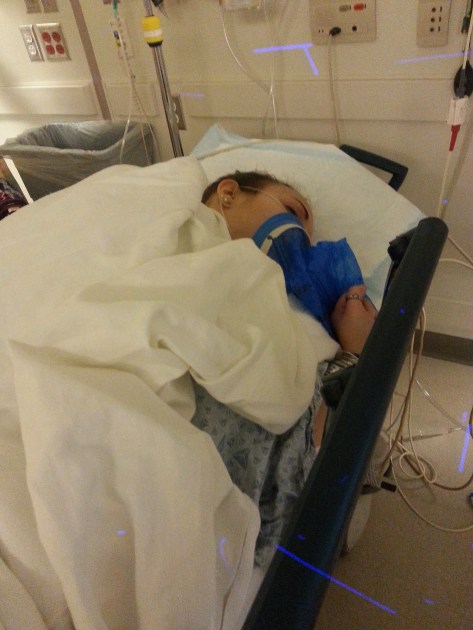
20160114_184118

So back to waiting.  Give my husband the remote and he’s a happy man.
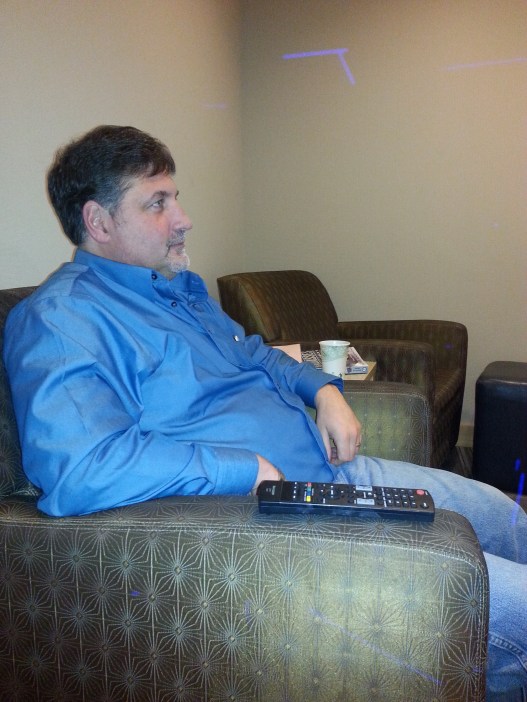
20160114_181050.jpg

Lauren was suppose to stay in the Shapiro Building, but they didn’t have any rooms so they moved to the Towers Building.  I kept thinking Lauren was going to be upset, we never stayed there and she wouldn’t be able to see any familiar faces.  Come to find out it didn’t matter.  Lauren was so sick during the night, throwing up from all the meds she was given.  The room we stayed in was in the Pavilion Suites.  They really upgraded her.  This floor is for celebrities or you have to pay big time to be able to stay there.  Talk about a hospital room.  Imagine this, hardwood floors, cherry trim all around.  The menu could have been from a 5 star restaurant.  She deserved it.  But she didn’t know where she was until the next morning when she woke up.

This is how they served the meals, room service style.  Lauren’s breakfast.

20160115_110326.jpg

That morning we told Lauren about what happened during her surgery.  She was shocked to find out she was in surgery for 6 hours and she had 3 fistula’s instead of one.  Lauren did have quite a few visitors from the Shapiro Building that took care of her.  They found out where she was and everyone kept saying “wow, how did you get this floor”.  It made her feel very special and she was able to visit with old friends.

It was a long trip for my husband and I, but the end result was Lauren was doing great now.  Sore but good.  They took great care of her and we were told they are not concerned at this time about the last fistula they could not repair.  Maybe down the road, but not at this point.

It has been two weeks since her surgery, last Friday the three of us got back in the car and  had our appointment with Lauren’s surgeon for a follow-up.  All is good.  Lauren is still sore, but we were told it is normal healing.

Thank you Brigham and Women’s Hospital for taking great care of our daughter again.

With much love

Lynne, Dean & Lauren 1437940979_love_valentines_day_11

Back to Boston, for Lauren’s surgery


This is a follow-up on a past post, about what they found when Lauren had her heart biopsy done.  An arteriovenous fistula.

An arteriovenous (AV) fistula is an abnormal connection between an artery and a vein. Normally, blood flows from your arteries to your capillaries to your veins. Nutrients and oxygen in your blood travel from your capillaries to tissues in your body.

With an arteriovenous fistula, blood flows directly from an artery into a vein, bypassing some capillaries. When this happens, tissues below the bypassed capillaries receive a diminished blood supply.

Surgery is scheduled for this Thursday morning at Brigham and Women’s Hospital in Boston Ma.  So many emotions, I know how I feel inside, but I am concerned how Lauren is feeling.  She always puts up a brave front, she must get it from her mother.

My husband wanted to get a hotel room for the night.  He told me that there is no way he will allow me to spend the night in the hospital, just from a emotional concern.  Right now I am going through some medical problems with my back and my sciatica nerve which makes walking difficult at this time.  The hotel is right down the street, but it might as well be 100 miles away.  So we decided we will spend the night in the hospital sleeping in the family room like we have done so so many times before.  To be honest, I feel better  knowing I will be closer to Lauren.  We were told it would be only an over nighter, so I am holding them to it.  NO COMPLICATIONS………….

I know when my sister Donna reads this, she will know exactly where I am talking about because she has spent so many nights sleeping in that room when she would come up to see us.

Time to see some old friends in Boston.

This is cute, when Lauren found out the date she contacted some of her favorite nurses to see if they were working that day or night.  I think she is looking at this as a social event, which is nice.  It takes all the medical out of the visit.

Lynne 1437940979_love_valentines_day_11

Generosity won’t fix our shortage of organs for transplants


I came across this article, thought I would share.  not to sure how I feel about it.  Let me know your thoughts.

Generosity won’t fix our shortage of organs for transplants

By Sally Satel December 28, 2015

Surgeons begin a kidney removal at the California Pacific Medical Center in March. (California Pacific Medical Center via Reuters)
Each week, In Theory takes on a big idea in the news and explores it from a range of perspectives. This week we’re talking about government compensation for organ donors. Need a primer? Catch up here.

Sally Satel is a resident scholar at the American Enterprise Institute and a lecturer in psychiatry at Yale University School of Medicine. She is the editor of “When Altruism Isn’t Enough: The Case for Compensating Kidney Donors.”

My interest in the national organ shortage began one steamy afternoon in August 2004. That day, my doctor told me my kidneys were failing. As a physician myself, I knew immediately that I would need to find a replacement organ or else face a shortened life tethered to a dialysis machine. My search was rocky at first, but finally I did get a kidney from a casual friend — now a very dear one.

At the time of my search, there were about 60,000 people on the national waiting list maintained by the United Network for Organ Sharing. Today, a decade later, there are roughly 101,000. Meanwhile, donation rates from both living and deceased donors are effectively flat. The death toll is 12 people per day — individuals who could not survive the years-long wait for an organ.

Clearly, our current organ transplant policy is a qualified failure. And it is because our current system, by law, mandates altruism as the sole legitimate motive for organ donation. We need to give more healthy young and middle-age people a reason to become living donors.

[It’s time to talk honestly about dying]

Tragically, altruism is not enough. The yield from public awareness campaigns, the organ procurement teams that meet with families of the recently deceased and the reimbursement for donors’ expenses has leveled off. Moving to an opt-out system, under which we would harvest people’s organs at death unless they had earlier indicated they didn’t wish to donate them, can do only so much — relatively few people die in ways that leave their organs suitable for transplantation.

So, to save lives, let’s test incentives. A model reimbursement plan would look like this: Donors would not receive a lump sum of cash; instead, a governmental entity or a designated charity would offer them in-kind rewards, such as a contribution to the donor’s retirement fund; an income tax credit or a tuition voucher; lifetime health insurance; a contribution to a charity of the donor’s choice; or loan forgiveness.

Meanwhile, the law can impose a waiting period of at least six months before people donate, ensuring that they don’t act impulsively and that they offer fully informed consent. Prospective compensated donors would be carefully screened for physical and emotional health, as all donors are now. These arrangements would filter out financially desperate individuals who might otherwise rush to donate for a large sum of instant cash and later regret it.

The donors’ kidneys would be distributed to people on the waiting list, according to the rules now in place. (People who wanted to donate a kidney to a specific person — say, a father to a son — would still be able to, alongside this system.) Finally, all rewarded donors would be guaranteed follow-up medical care for any complications, which is not ensured now.

The good news is that the general notion of incentivizing donations is gaining traction. A 2009 poll of the membership of the American Society of Transplant Surgeons revealed that 80 percent supported or were neutral toward the provision of tax credits for donors. In 2014, the American Society of Transplantation and the American Society of Transplant Surgeons published the results of a workshop in which the societies expressed approval of testing third-party, in-kind incentives. A few weeks ago, the American Medical Association passed a resolution in favor of testing the effect of incentives on living and deceased donation. (A reward for deceased donation could take the form of a funeral subsidy or a contribution to the estate of the deceased.)

[Why are doctors afraid of the word ‘death’?]

The objections I heard years ago seem to be wearing thin. Take the objection that rewarding donors “commodifies the body.” We already commodify the body, speaking strictly, every time there is a transplant: The doctors get paid to manipulate the body. So does the hospital and the agency that obtains and transports the organ. Why would we now object to enriching the donor — the sole individual in this entire scenario who gives the precious item in question and assumes all the risk?

At the heart of the “commodification” claim is really the concern that donors will not be treated with dignity. But dignity is affirmed when we respect the capacity of individuals to make decisions in their own best interest, protect their health and express gratitude for their sacrifice. Material gain, per se, is not inconsistent with this. The true indignity is to stand by smugly while thousands of people die each year for want of an organ.

Some worry that that rewarded donation will attract only low-income people. This is possible, though only a trial project can provide the answer. But even if this turns out to be the case, why doubt the capacity of low-income people to make decisions in their own interest? From the standpoint of the recipient, it is low-income individuals who stand to benefit the most, as they are disproportionately represented among those waiting for a kidney.

Yet regardless of who ends up donating, any plan must ensure that donors’ decisions are thoroughly informed, their health is protected and they are amply rewarded. As the organ waiting list grows, the need to test incentives becomes stronger and stronger.

We need to liberate patients from the tyranny of “the gift.” It’s glorious when you are the recipient, as I know better than most, but the penalty for being unlucky should not be premature death. Hollow moralizing from critics in the face of so much needless suffering must be replaced by sensitive and pragmatic policy.

Biopsy results are in


NO REJECTION

News we were praying for.

I wish I could say it smooth sailing now, but when Lauren was in surgery having her biopsy the Dr. found that Lauren has an arteriovenous fistula in her groin area.  When you hear the Dr. trying to explain to you what it is, all I heard was Lauren has something wrong and she might need surgery.  I went numb.   At this point, we spoke with her transplant team yesterday, yes they gave us the great news no rejection, but they also told us the they are contacting a vascular surgeon.  Our first appointment they told us will probably be they will need to do an ultra sound  to see the extent of the fistula.  Then we will know more.  To try to explain what I am talking about:

An arteriovenous (AV) fistula is an abnormal connection between an artery and a vein. Normally, blood flows from your arteries to your capillaries to your veins. Nutrients and oxygen in your blood travel from your capillaries to tissues in your body.

With an arteriovenous fistula, blood flows directly from an artery into a vein, bypassing some capillaries. When this happens, tissues below the bypassed capillaries receive a diminished blood supply.

Causes of arteriovenous fistulas include:  This is how Lauren’s biopsy procedure is done.

Cardiac catheterization. An arteriovenous fistula may develop as a complication of a procedure called cardiac catheterization. During cardiac catheterization, a long, thin tube called a catheter is inserted in an artery or vein in your groin, neck or arm and threaded through your blood vessels to your heart.

If the needle used in the catheterization crosses an artery and vein during your procedure, and the artery is widened (dilated), this can create an arteriovenous fistula. This rarely happens.

Catheterization procedure
The patient lies face up on a table during the catheterization procedure, and is connected to a cardiac monitor . The insertion site is numbed with a local anesthetic, and access to the vein or artery is obtained using a needle. A sheath, a rigid plastic tube that facilitates insertion of catheters and infusion of drugs, is placed in the puncture site. Under fluoroscopic guidance, a guide-wire (a thin wire that guides the catheter insertion) is threaded through a brachial or femoral artery to the heart. The catheter, a flexible or preshaped tube approximately 32–43 in (80–110 cm) long, is then inserted over the wire and threaded to the arterial side of the heart. The patient may experience pressure as the catheter is threaded into the heart. The contrast agent, or dye, used for imaging is then injected so that the physician can view the heart and surrounding vessels. The patient may experience a hot, flushed feeling or slight nausea following injection of the contrast medium. Depending on the type of catheterization (left or right heart) and the area being imaged, different catheters with various shapes and ends are used.

F3.large Hope this picture helps explain.

The procedure usually lasts about two or three hours. If further intervention is necessary, an angioplasty, stent implantation, or other procedure can be performed. At the end of the catheterization, the catheter and sheath are removed, and the puncture site is closed using a sealing device or manual compression to stop the bleeding. One commonly used sealing device is called Perclose, which allows the doctor to sew up the hole in the groin. Other devices use collagen seals to close the hole in the femoral artery.

The femoral blood vessels are important conduits for blood traveling between the heart and lower limb. The femoral artery carries blood to the lower limb while the femoral vein carries blood back to the heart. These structures are common sites for conditions that cause narrowing or blockage of the blood vessels.

This past week-end, I kinda lost it.  The thought of something wrong, living in the hospital again was very overwhelming.  I needed to get my anger out and thank god for my family, I took it out on them.  Mom, Donna and Laureen sorry, but thank you.  Your family is the only ones that you can let loose and know they are there for you.

Will post when we hear more.

Lynne1437940979_love_valentines_day_11